Crypto Wallets: Hardware, Software and Multisig
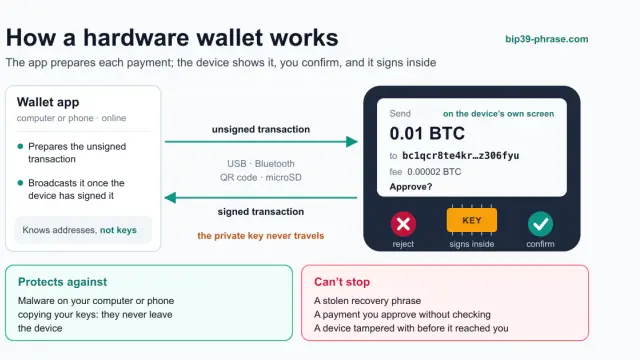
A wallet does not hold coins: it holds the keys that control them. Whether those keys sit on a hardware device, in a desktop app, with an exchange or split across a multisig setup decides who can move your funds and what happens when something breaks. These comparisons help you choose and set up the right one.
Start here
More in Wallets
- Hardware Wallets Compared: Ledger, Trezor, Keystone and More
Ledger, Trezor, Keystone, COLDCARD, BitBox, Jade, Passport and Tangem compared: key chips, open firmware, screens, backups and coins, from makers' own specs.
- How to View Your Seed Phrase in MetaMask, Trust and More
Where MetaMask, Trust Wallet, Phantom, Coinbase Wallet, Exodus, Electrum and BlueWallet show your recovery phrase, and why Ledger and Trezor never do.
- What Is a Hot Wallet? How It Works, Types and Examples
A hot wallet keeps its private keys on an internet-connected phone, computer or browser so it can sign at once. How it works, main types, examples and risks.
- How to Store Crypto Safely: A Hot, Cold and Backup Plan
A practical plan for storing crypto: a small hot wallet for spending, cold storage for savings, separate backups and safe transfers between them.
- Custodial vs Non-Custodial Wallet: Differences and How to Choose
A custodial wallet means a company holds your private keys; a non-custodial wallet leaves them with you. How they differ on recovery, KYC, freezes and fees.
- How Does Multisig Work for Bitcoin? 2-of-3 Explained
A Bitcoin multisig wallet needs M of N keys to sign, such as any 2 of 3. How the script works, which setup to pick, what to back up and what it costs.
- Crypto Exchange vs Wallet: What's the Difference?
An exchange is a marketplace that usually holds your coins for you; a wallet holds the keys that control them. Control, security, fees and how to withdraw.
- Electrum Bitcoin Wallet: How to Set Up, Back Up and Use It
Electrum is a lightweight, non-custodial Bitcoin wallet first released in 2011. How to install it safely, back up its seed, pair a hardware wallet and send BTC.
- Which Wallets Let You Hold Your Own Seed Phrase and Keys?
Non-custodial wallets give you the seed phrase: most hardware, mobile, desktop and extension wallets show one at setup, while exchange accounts never do.
- What Is a Crypto Wallet? What It Stores and How It Works
A crypto wallet stores keys, not coins. What a wallet keeps, how a private key becomes an address, and what the seed phrase and the password each protect.
Tools
PDF documents on this topic
All 28 printable explainers on this topic, including the PDF archive, newest first.
- Watch-Only Wallets: Tracking Funds Without Private Keys · October 18, 2026
A technical explanation of how watch-only wallets derive addresses, prepare PSBTs using extended public keys, and manage privacy risks.
- Air-Gapped Signing with PSBT and QR Codes · June 2, 2026
Learn how PSBTs decouple transaction construction from signing via QR codes and SD cards, and how to verify change addresses and fees offline.
- Inscription-Aware Wallets and UTXO Protection · May 26, 2026
Learn how inscription-aware wallets and UTXO freezing prevent standard Bitcoin coin selection algorithms from spending Ordinals as fees.
- Collaborative Custody: The Service Key Model · May 7, 2026
Understand how collaborative multisig balances self-custody with an institutional key, including recovery paths if the company goes offline.
- Mining Pool Payouts to a Self-Custody Wallet · May 2, 2026
Configure mining pool rewards directly to a verified self-custody wallet, handle UTXO consolidation, and understand payout maturity rules.
- Hardware Wallet Attestation: How Apps Detect Fakes · April 22, 2026
Learn how companion apps use cryptographic attestation to detect counterfeit hardware wallets, and review the essential supply-chain checklist.
- Ledger Wallet and Ledger signer · March 2, 2026
- Guide to Choosing the Right Web3 Wallet · February 24, 2026
Custodial wallets (like those on centralized exchanges) require you to entrust your private keys to third parties.
- Secure Element vs General-Purpose Chip in Wallets · February 16, 2026
Compare Secure Elements and microcontrollers in hardware wallets: physical attack resistance, open-source firmware trade-offs, and dual-chip designs.
- What Is Axie Infinity · January 24, 2026
Gaming is one of the world’s fastest-growing industries. The industry is expected to reach a massive $314.40 billion by 2025, up by nearly 10% from where…
- Features of Ledger Wallet · January 18, 2026
- Unboxing Your Ledger Flex · January 14, 2026
Your Ledger Flex, in combination with the Ledger Wallet app, transforms your experience by putting you in control of your digital life.
- Wallet Confirmation Message · December 26, 2025
Cryptocurrency is an innovative, fast-paced, and often complex space, where the UX can often be hard to understand.
- Leather (Hiro) Wallet · December 10, 2025
Bitcoin is the most popular cryptocurrency not just because it is the first, but because it is the perfect store of value.
- Seedless Wallets · December 2, 2025
- How to Track Solana Wallets · November 18, 2025
A Solana wallet is a digital tool designed for the Solana blockchain, allowing you to store and manage your private keys, send and receive assets, and access…
- Ledger Devices: Which Is Best For Me? · November 5, 2025
Ledger's journey began in 2014, with a vision to create a security-focused solution for managing private keys.
- From Hardware Wallet to signer · November 4, 2025
The world of digital assets has transformed dramatically since Ledger launched in 2014.
- How To Create an Ethereum Wallet · October 29, 2025
Creating an Ethereum wallet is a straightforward yet crucial step for anyone engaging with the Ethereum blockchain.
- What Is a Burner Wallet? · October 28, 2025
A burner wallet is a single-use crypto account.
- How To Get a Crypto Wallet · October 27, 2025
- Why Hot and Cold Wallets Must Never Share a Seed · October 24, 2025
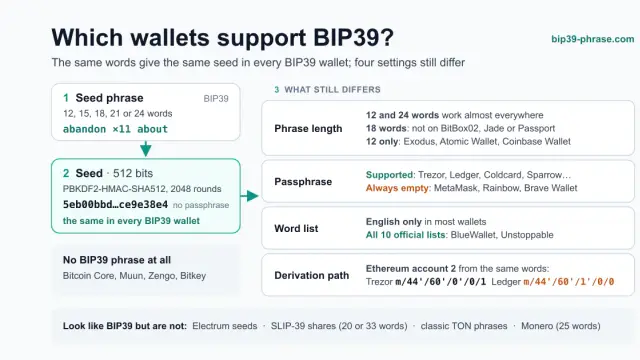
Sharing a BIP39 seed across hot and cold wallets destroys physical isolation. Learn why separate seeds and watch-only setups are required.
- Secure Boot: How Hardware Wallets Check Firmware · October 3, 2025
Secure boot uses cryptographic signature verification at startup to prevent malicious firmware from extracting your BIP39 seed phrase.
- Connect Keystone 3 Pro to VESPR Wallet: Send Cardano · March 29, 2025
How to connect a Keystone 3 Pro hardware wallet to the VESPR mobile wallet and sign a Cardano transaction by QR code. Random BIP39 word sequences follow as format examples.
- Connect Keystone 3 Pro to Fewcha Wallet: Aptos and Sui · March 28, 2025
How to set up the Fewcha browser extension, import a Keystone 3 Pro hardware wallet into it, send Aptos and switch the network to Sui. Random BIP39 word sequences follow as format examples.
- Connect Keystone 3 Pro to Petra Wallet: Import by QR Code · March 27, 2025
How to connect a Keystone 3 Pro hardware wallet to the Petra browser extension: set up a Petra wallet, then import the Keystone account by scanning a QR code. Random BIP39 word sequences follow as format examples.
- Connect Keystone 3 Pro to Solflare: Send SOL Step by Step · March 26, 2025
How to connect a Keystone 3 Pro hardware wallet to the Solflare browser extension and send SOL, signing the transaction by QR code. Random BIP39 word sequences follow as format examples.
- Connect Keystone 3 Pro to Helium Wallet: Step-by-Step · March 25, 2025
How to connect a Keystone 3 Pro hardware wallet to the Helium Wallet mobile app, then send and swap tokens with QR-code signing. Random BIP39 word sequences follow as format examples.