Crypto Inheritance: How to Pass On Your Seed Phrase
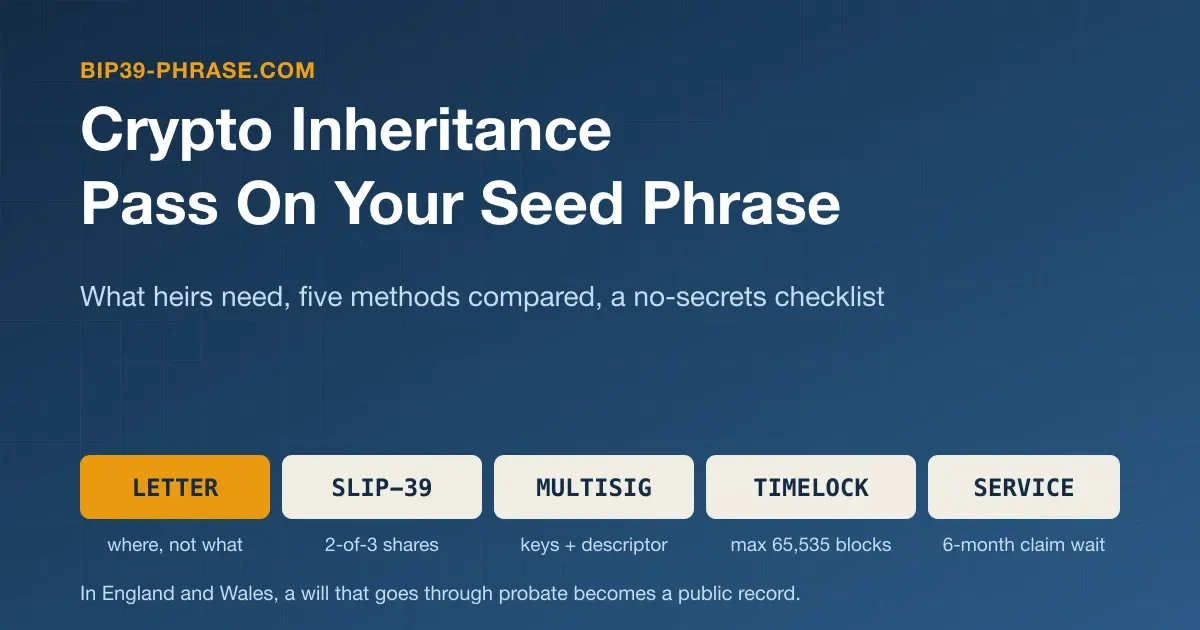
Crypto inheritance means arranging things so that the people you choose can reach your coins after you die or can no longer act, while nobody can reach them before. For self-custodied crypto it comes down to one fact: whoever holds the seed phrase, plus the passphrase if you set one, controls the funds, and there is no bank or password reset to fall back on. A working inheritance plan, for bitcoin or any other coin, keeps the backup and the instructions apart and gets both to the right people at the right time. This guide covers what heirs need, five ways to pass on access, why the phrase stays out of your will, a letter of instruction checklist and testing. New to recovery phrases? Start with how a seed phrase works.
Not legal or tax advice. Inheritance law differs between countries and states, so ask an estate lawyer how to make your plan valid where you live.
Why Self-Custodied Crypto Is Lost Without a Plan
The developer of a non-custodial wallet does not hold your phrase and cannot restore it. If nobody finds your backup or understands it, the coins stay on the blockchain, unspendable. And the words alone are often not enough:
- A passphrase opens a different wallet. BIP39 makes every passphrase produce a valid wallet, so an heir who does not know about yours restores a different wallet, usually an empty one, and sees no error (how the passphrase works).
- Wallet settings matter. The same words give different addresses on different derivation paths, and not every phrase is BIP39: Electrum, for one, does not generate BIP39 seeds (Electrum seed vs BIP39).
- Multisig and time-locked wallets also need their configuration.
The opposite failure is as real: a backup many people can reach can be stolen or spent early. Every method below balances the two.
What Your Heirs Will Need
Whatever the method, heirs need:
- To know the crypto exists. Coins nobody knows about usually go unclaimed.
- The backup. A BIP39 phrase, SLIP-39 shares or multisig seeds, on paper or metal.
- The passphrase, if any. Stored apart from the words, but findable.
- The wallet details. App or device, address type, derivation path, accounts and networks.
- Instructions and a helper. Plain steps, and someone technical to ask.
Wallet details cannot spend anything, so they can be written down. For the public BIP39 test phrase (abandon eleven times, then about; never send funds to it):
Backup type:         BIP39, 12 words, no passphrase
Script type:         Native SegWit (P2WPKH), BIP84
Account path:        m/84'/0'/0'
Master fingerprint:  73c5da0a
First address:       bc1qcr8te4kr609gcawutmrza0j4xv80jy8z306fyu
That address is the official BIP84 test vector. An heir who restores the wallet and sees the same first address knows the words, passphrase and path are right. Anyone who reads the address can also look up its history, so keep the document private.
Five Ways to Pass On Access
Sealed Letter Plus Separate Storage
The backup stays in secure storage (see how to store a seed phrase), and a letter of instruction with no secrets in it tells your heirs where it is and what to do. The letter can sit with your estate documents or your lawyer; the backup goes where your executor can reach it.
It is cheap, and any compatible wallet can restore the backup. The weakness: whoever finds it, before or after your death, can take everything. A passphrase kept elsewhere adds a second factor, as long as the letter says it exists.
SLIP-39 Shares
SLIP-39 uses Shamir’s secret sharing to split a wallet’s master secret into shares, any threshold number of which restores it. Fewer shares than the threshold reveal nothing about the secret, so in a 2-of-3 set one lost or stolen share does no harm. The spec allows up to 16 shares per group and 16 groups, so friends and family can hold separate groups. Each share is written in words from a separate 1,024-word list: 20 of them for a 128-bit secret, 33 for a 256-bit one.
Trezor calls this Multi-share Backup and supports it on the Safe 7, Safe 5, Safe 3 and Model T. A 20-word single-share backup made since June 2024 can be upgraded in Trezor Suite under Settings → Device → Create Multi-share Backup, but the original backup stays valid and still needs protecting. A 12- or 24-word wallet, or a 20-word one from before June 2024, cannot be upgraded: you create a new wallet and move the funds. SLIP-39 vs BIP39 compares the formats.
Heirs need enough shares and a wallet that restores SLIP-39, and shareholders who reach the threshold can restore it without you, so pick people unlikely to collude.
Multisig With a Trusted Person or Heir
In a multisig wallet, a set number of its keys must sign each spend. One inheritance layout is 2-of-3: you keep two keys in different places and an heir or trusted person holds the third. You can spend alone, the heir cannot, and after your death the heir adds one of your keys, found through the letter.
The catch is the configuration. The script behind a multisig address lists every cosigner’s public key (BIP 383), so two seeds alone cannot find the coins: the wallet also needs the third public key, usually saved as an output descriptor or a configuration file. Keep a copy with every key. It cannot spend, but it reveals balances and history.
Time-Locked Recovery Path
Bitcoin scripts can add a second spending path that opens only after a delay. In Liana, an open-source wallet, your primary key spends at any time, and a recovery key, such as an heir’s, only after a period of inactivity you choose. The timelock is relative: the clock starts when each coin is received, and each coin must be spent at least once per timelock period to keep the recovery path closed; when that path is close to opening, Liana v15’s home screen offers a Reset timelock button that does it with a transaction to yourself. BIP 68 caps a block-based relative timelock at 65,535 blocks, about 15 months. After the delay, the heir restores the wallet from its descriptor, opens the Recovery menu and sends the coins to another wallet, signing with the recovery key.
In Nunchuk’s on-chain design, the wallet is 2-of-4 with Nunchuk’s Platform Key until the timelock and 1-of-3 without it afterward; the beneficiary needs the inheritance key and the wallet configuration, and postponing the timelock takes a guided migration.
The heir cannot spend early, but if you forget to refresh, the recovery path opens while you are alive, and each refresh costs a fee.
Inheritance Services
Inheritance services follow a few patterns, going by their own documentation:
- A key holder with a claim process. In Casa, your recipient holds an encrypted copy of your mobile key that cannot sign until an inheritance request unlocks. A request starts a six-month verification period in which Casa tries to reach you and you can cancel; after it, the recipient signs with that key and requests a signature from the Casa Recovery Key. In a vault that needs three signatures, you also share a hardware wallet and its seed phrase with the recipient, and Private Clients with Enhanced Verification skip the wait in exchange for identity checks.
- A beneficiary feature in the wallet. In Bitkey, a beneficiary can start a claim at any time, followed by a mandatory six-month waiting period with alerts to the owner, who can cancel it.
- A date set off-chain. Nunchuk’s off-chain option lets a beneficiary claim only from a date you choose, which you can change without moving funds or paying network fees; Nunchuk holds one key of your multisig, which needs several keys to spend.
They can spare heirs much of the technical work, but they tie the plan to a company: check the fees, and ask what happens if the provider shuts down.
Comparing the Approaches
| Approach | Security | Complexity | What heirs must do |
|---|---|---|---|
| Letter plus storage | One backup controls everything; a passphrase adds a factor | Low | Find the backup, restore in a compatible wallet, add the passphrase |
| SLIP-39 shares | Fewer shares than the threshold reveal nothing; enough holders together can restore | Medium | Collect the threshold of shares, restore in a SLIP-39 wallet |
| Multisig, 2-of-3 | No single key can spend; descriptor needed | High | Gather two keys and the descriptor, restore in a multisig wallet |
| Time-locked recovery | Heir’s key works only after the timelock; coins need refreshing | Medium to high | Wait out the timelock, load the descriptor, sign the recovery spend |
| Inheritance service | A waiting period or timelock blocks early claims; depends on the company | Low to medium | File a claim, wait (six months at Bitkey, and at Casa by default), then sign or transfer |
Why the Seed Phrase Does Not Belong in Your Will
A will passes through many hands: lawyers, executors, family, sometimes a court. It can also become public: in England and Wales, the government’s probate guidance says the will is kept by the probate registry and becomes a public record; once probate is issued, copies can be ordered online. Rules elsewhere differ. Wills are also updated rarely, while wallets change often.
Keep the words in secure storage and only instructions in documents. Your lawyer can advise how the will should mention your digital assets and the letter.
Letter of Instruction Checklist
Write for a non-technical reader, date it, and keep every secret out: no words, passphrase or PINs. Include:
- Inventory. Each wallet, its coins and networks, and roughly how much it holds.
- Backup type. BIP39 and the word count, an Electrum seed, SLIP-39 shares and their threshold, or the multisig quorum.
- Locations. Where every backup, share, key and device is, not what it says.
- Passphrase. Whether one exists and where its separate backup is.
- Wallet details. App or device and version, script type, derivation path, accounts.
- A check value. The first receiving address or the master fingerprint.
- Multisig and timelock details. Who holds which key, where the descriptor copies are, when a recovery path opens.
- Custodial accounts. Exchanges and the email each account uses, never passwords; the executor or other legal representative claims them through each exchange.
- Steps. Install the wallet from its official site, restore on a clean device, check the first address, then move the funds to a new wallet the heir controls.
- People. The executor, a technical helper and your lawyer.
- Warnings. Never type the phrase into a website; no support agent, lawyer or recovery service needs it.
Testing the Plan
Test without exposing the real backup:
- Rehearse. Have your heir follow the letter to restore a practice wallet, or the public test phrase, in the same app; the restore guide has steps for popular wallets.
- Check the real backup yourself. Use the hardware wallet’s own check, such as Check backup under Device settings → Wallet backup in Trezor Suite, or Ledger’s Recovery Check app. Each compares the words you enter with the backup the device holds.
- Restore the configuration. For multisig or Liana, confirm that a fresh install plus the descriptor shows your addresses.
- Walk the route. Make sure the heir can reach every location named.
Keeping the Plan Current
Review the plan yearly and after any change: a new wallet, device, address type or passphrase, new heirs, a move, or a wallet app that is discontinued. Record the standards (BIP39, BIP84, the path), not just app names, put timelock refreshes in your calendar, and destroy old letters.
Common Mistakes
- The phrase in the will, a cloud note or an email to a relative.
- A passphrase only you know, or one stored next to the words: the first locks heirs out, the second removes its protection.
- No wallet details. Right words, wrong app or path: a zero balance. See finding lost wallet backups.
- Multisig keys without the descriptor.
- Cutting a phrase in half between two people. Each half gives away part of the secret: whoever holds six words of a 12-word phrase faces about 2⁶² possibilities instead of 2¹²⁸, and losing either half loses the wallet.
- Forgetting to refresh time-locked coins, or not telling heirs they must wait.
- Backup and letter in one envelope.
- Trusting anyone who offers to unlock the inheritance for a fee or a share; see common seed phrase scams.
Frequently Asked Questions
Can I put my seed phrase in my will?
It is safer not to. Many people handle a will, and in England and Wales a will that goes through probate becomes a public record. Keep the words in secure storage and let a letter of instruction say where to look.
What happens to crypto if nobody has the seed phrase?
Coins in a self-custodied wallet stay on the blockchain, but nobody can move them. Coins on an exchange are different: the exchange holds the keys, so the estate’s legal representative files a claim with it. Kraken, for example, asks for a death certificate, proof of appointment such as probate, photo ID and a signed letter.
Do my heirs need my hardware wallet and its PIN?
No. The PIN only unlocks that one device. With the backup, plus any passphrase, heirs can restore the wallet on a new device or in a compatible app. Multisig and time-locked wallets also need their descriptor.
Is SLIP-39 or multisig better for inheritance?
They solve different problems. SLIP-39 splits the backup of a single-signature wallet, which controls the coins once enough shares are combined. Multisig needs several signatures for every spend: stronger against theft, harder for heirs.