- Home
- / Blog
- / BIP Standards
- / Derivation Path Explained: What m/44'/0'/0'/0/0 Means
Derivation Path Explained: What m/44'/0'/0'/0/0 Means
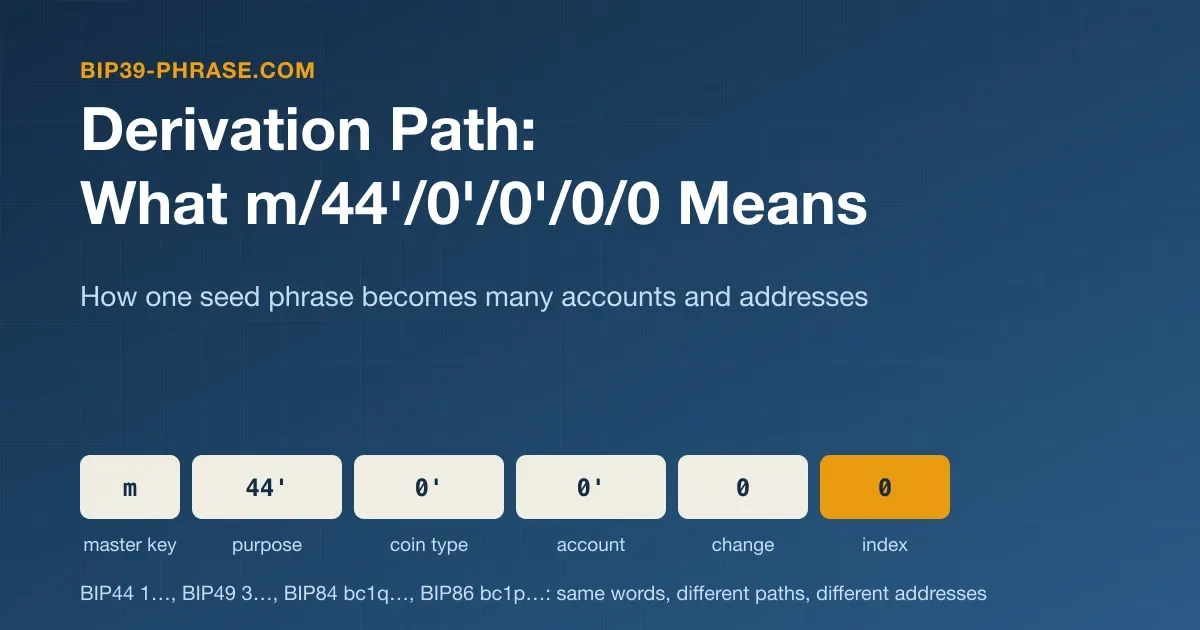
A derivation path is the address of one key in the tree of keys a wallet builds from a seed phrase. The notation m/44'/0'/0'/0/0 lists the steps from the master key down to a single private key and its address. The phrase does not record which path was used: the same 12 or 24 words give different addresses on different paths, which is why a restored wallet sometimes shows a zero balance. This guide explains what each number means, which paths Bitcoin, Ethereum and other networks use, and how to check them with a public test phrase.
Reading a BIP44 Derivation Path
BIP39 turns the words into a 512-bit seed, and the seed becomes a master key, written m, under the rules of BIP32 hierarchical deterministic wallets. Each step of the path then derives a child key from the one before it. BIP44 assigns every position a meaning, which our BIP44 multi-account hierarchy guide covers in depth:
| Level | In the example | Meaning |
|---|---|---|
m | m | Master key derived from the seed |
purpose' | 44' | Which scheme the tree follows, by BIP number (BIP43) |
coin_type' | 0' | Network, per the SLIP-44 registry: 0 is Bitcoin, 60 is Ethereum |
account' | 0' | Account number, counted from zero |
change | 0 | 0 for receiving addresses, 1 for change addresses |
address_index | 0 | Address number in that chain: 0, 1, 2… |
So m/44'/0'/0'/0/0 is the first receiving address of the first Bitcoin account; m/44'/0'/0'/0/1 is the second, m/44'/0'/0'/1/0 the first change address and m/44'/0'/1'/0/0 the first address of a second account.
What the Apostrophe Means
An apostrophe marks a hardened step, which adds 2³¹ to the number, so 44' is index 0x8000002C. Output descriptors (BIP380) write 84h for 84'.
The public keys of normal children can be computed from the parent’s extended public key (xpub) alone, which lets a watch-only wallet generate addresses without private keys. But BIP32 warns that an xpub plus any private key from a normal branch below it reveals the parent’s private key. So purpose, coin type and account are hardened, keeping a leak in one account away from the master key and the other accounts, while change and index stay normal so the account xpub can still produce addresses.
Bitcoin Derivation Paths: BIP44, BIP49, BIP84 and BIP86
In Bitcoin, the purpose number selects the address type. The table lists the first receiving address for the public test phrase abandon abandon abandon abandon abandon abandon abandon abandon abandon abandon abandon about with an empty passphrase. The addresses are official SLIP-132 and BIP86 test vectors that anyone can reproduce, so never send coins to them.
| Standard | Path | Address type | Starts with | First address |
|---|---|---|---|---|
| BIP44 | m/44'/0'/0'/0/0 | Legacy (P2PKH) | 1 | 1LqBGSKuX5yYUonjxT5qGfpUsXKYYWeabA |
| BIP49 | m/49'/0'/0'/0/0 | Nested SegWit (P2WPKH in P2SH) | 3 | 37VucYSaXLCAsxYyAPfbSi9eh4iEcbShgf |
| BIP84 | m/84'/0'/0'/0/0 | Native SegWit (P2WPKH) | bc1q | bc1qcr8te4kr609gcawutmrza0j4xv80jy8z306fyu |
| BIP86 | m/86'/0'/0'/0/0 | Taproot (P2TR) | bc1p | bc1p5cyxnuxmeuwuvkwfem96lqzszd02n6xdcjrs20cac6yqjjwudpxqkedrcr |
BIP49, BIP84 and BIP86 are deliberately incompatible with BIP44: a wallet that lacks one of them will not find those accounts at all and shows an empty wallet instead.
Ethereum Derivation Path: MetaMask vs Ledger Wallet
Ethereum’s coin type is 60, and MetaMask and Ledger Wallet both put the first account at m/44'/60'/0'/0/0. From the second account on they differ. MetaMask keeps the branch m/44'/60'/0'/0 and raises the last number; Ledger Wallet (called Ledger Live until 2025) raises the account number instead: m/44'/60'/x'/0/0. You may also meet two older schemes: Ledger’s old Chrome app used a single address at m/44'/60'/0'/0, and MyEtherWallet and MyCrypto listed Ledger addresses at m/44'/60'/0'/x, the path MetaMask calls Legacy (MEW / MyCrypto) when you connect a Ledger.
| Account | MetaMask | Ledger Wallet |
|---|---|---|
| First | m/44'/60'/0'/0/0: 0x9858EfFD232B4033E47d90003D41EC34EcaEda94 | Same path and address |
| Second | m/44'/60'/0'/0/1: 0x6Fac4D18c912343BF86fa7049364Dd4E424Ab9C0 | m/44'/60'/1'/0/0: 0x78839F6054d7ed13918bAe0473BA31b1Ca9D7265 |
MetaMask says it supports only its default path, m/44'/60'/0'/0, for an imported Secret Recovery Phrase, so Ledger Wallet accounts after the first will not appear there. Each key controls the same 0x address on every EVM chain; how EVM addresses are built explains why.
Ed25519 Networks: Every Step Is Hardened
Solana, Stellar, TON and some other networks use the ed25519 curve and SLIP-10 derivation, which for ed25519 allows hardened steps only: every number carries an apostrophe, and no child key can be computed from a parent public key. SLIP-10 also derives the master key with a different constant (ed25519 seed instead of BIP32’s Bitcoin seed), so a familiar-looking path still gives unrelated keys.
Solana paths vary: m/44'/501'/0'/0' and m/44'/501'/0' are both in use, the prompt: input of the solana-keygen command-line tool defaults to the base path m/44'/501', and Phantom checks 20 addresses on each of its three supported paths when you import a phrase. A classic 24-word TON phrase uses no path at all: TON derives its single key with its own scheme.
Common Derivation Paths
| Network or app | Coin type | First key | Next account or address |
|---|---|---|---|
| Bitcoin, BIP84 | 0 | m/84'/0'/0'/0/0 | m/84'/0'/0'/0/1 |
| Ethereum, MetaMask | 60 | m/44'/60'/0'/0/0 | m/44'/60'/0'/0/1 |
| Ethereum, Ledger Wallet | 60 | m/44'/60'/0'/0/0 | m/44'/60'/1'/0/0 |
| Ethereum, Legacy (MEW / MyCrypto) | 60 | m/44'/60'/0'/0 | m/44'/60'/0'/1 |
| TRON, TronWeb library | 195 | m/44'/195'/0'/0/0 | Depends on the wallet |
| Solana | 501 | m/44'/501'/0'/0' | m/44'/501'/1'/0' |
| TON, 12-word multichain phrase | 607 | m/44'/607'/0' | m/44'/607'/1' |
| Stellar (SEP-0005) | 148 | m/44'/148'/0' | m/44'/148'/1' |
Coin type 1 is reserved for the testnets of all coins. TRON uses the same secp256k1 curve as Ethereum, but its own coin type gives it its own keys, and its addresses are Base58 strings that start with T: for the test phrase, m/44'/195'/0'/0/0 gives TUEZSdKsoDHQMeZwihtdoBiN46zxhGWYdH.
Extended Public Keys: xpub, ypub and zpub
The xpub format from BIP32 does not say which address type an account uses, so SLIP-132 registered other prefixes for Bitcoin: ypub for BIP49 and zpub for BIP84, with tpub, upub and vpub on testnet. Taproot has none of its own; BIP86 uses a plain xpub. Only the version bytes differ, not the key: for the test phrase, our converter shows the BIP84 account key as xpub6CatWdiZ…, and a SLIP-132 wallet shows the same key as zpub6rFR7y4Q….
BIP39 itself lists the lack of a versioning scheme among its shortcomings and says descriptor wallets now largely mitigate it: a descriptor (BIP380) such as wpkh([fingerprint/84h/0h/0h]xpub…/0/*) records the path and the address type together. Keep your xpub private: it reveals every address and the whole balance of the account.
Why a Restored Wallet Shows a Zero Balance
If the wallet accepts your phrase but shows zero, it is probably looking at the wrong branch of the tree:
- Address type. Your old addresses are the best clue: 1 usually means BIP44, 3 BIP49, bc1q BIP84 and bc1p BIP86. Restore with the same type.
- Account. BIP44 wallets check accounts in order and stop at the first account without transactions, so coins in account 1 stay hidden if account 0 was never used. Ethereum apps also number accounts at different levels.
- Network. An Ethereum address is the same on every EVM chain, but each chain has its own balance; TRON and Solana use separate branches of the tree.
- Gap limit. BIP44 wallets stop scanning after 20 unused addresses in a row, so later addresses are not found automatically.
- Passphrase. A different passphrase gives a different seed and a whole new tree; see how the BIP39 passphrase works.
The full restore procedure is in the guide to restoring a wallet from a seed phrase. If the wallet rejects the phrase itself, the path is not the problem: check the words first.
How to See Derivation Paths in the Converter
The seed phrase to private key converter computes keys in your browser and shows the path of every address. Use only the public test phrase: never type a real seed phrase into this or any other website.
- Paste the test phrase into BIP39 Mnemonic and leave BIP39 Passphrase empty.
- Bitcoin and the BIP44 tab are preselected. Full path reads
m/44'/0'/0'/0, and the first row under Derived Addresses ism/44'/0'/0'/0/0with 1LqBGSKuX5yYUonjxT5qGfpUsXKYYWeabA. - Open the BIP49, BIP84 and BIP86 tabs: only the purpose changes, and the first address becomes 37Vuc… on BIP49, bc1qcr8… on BIP84 and bc1p5cyx… on BIP86.
- Click the Ethereum (0x…) preset. The path becomes
m/44'/60'/0'/0, and the second row is MetaMask’s second account. - Type 1 into Account: the first row becomes
m/44'/60'/1'/0/0, Ledger Wallet’s second account. External / Internal switches the change level between 0 and 1. - On the BIP32 tab you type the path into Custom Derivation Path. A trailing normal number is replaced by the row number, so
m/44'/60'/0'/0lists the Legacy (MEW / MyCrypto) addresses.
Other quick presets include TRON (it reproduces the T… address above), Litecoin and Dogecoin. The converter does not handle ed25519 networks; their paths (Solana, Aptos, Sui, Polkadot) are on the private key generator page.
Frequently Asked Questions
What is the derivation path for Ethereum?
MetaMask and Ledger Wallet both use m/44'/60'/0'/0/0 for the first account. For the second, MetaMask uses m/44'/60'/0'/0/1 and Ledger Wallet m/44'/60'/1'/0/0.
Where can I find my wallet’s derivation path?
Check the wallet’s documentation or settings: Ledger Wallet shows it under Edit account > Advanced as freshAddressPath. Otherwise, let an old address guide you: its prefix points to the Bitcoin standard, and for Ethereum try the MetaMask, Ledger Wallet and Legacy paths.
Can I lose funds by choosing the wrong path?
No. A path changes nothing on the blockchain: the wallet just shows other, empty addresses, and the balance returns once you switch back. The real risk is receiving payments on a non-standard path and then forgetting which one.
Should I write down my derivation path?
It is not secret and gives no access to funds, so you can note it beside your backup with the wallet name, address type and account numbers. With default settings it is optional; with custom ones it saves time when you restore.
How is a derivation path different from a passphrase?
A path picks a branch inside one tree of keys; a passphrase changes the seed itself and produces a different tree. The path can stay public, but a passphrase needs the same protection as the seed phrase.