BIP 444 – Reduced Data Temporary Softfork
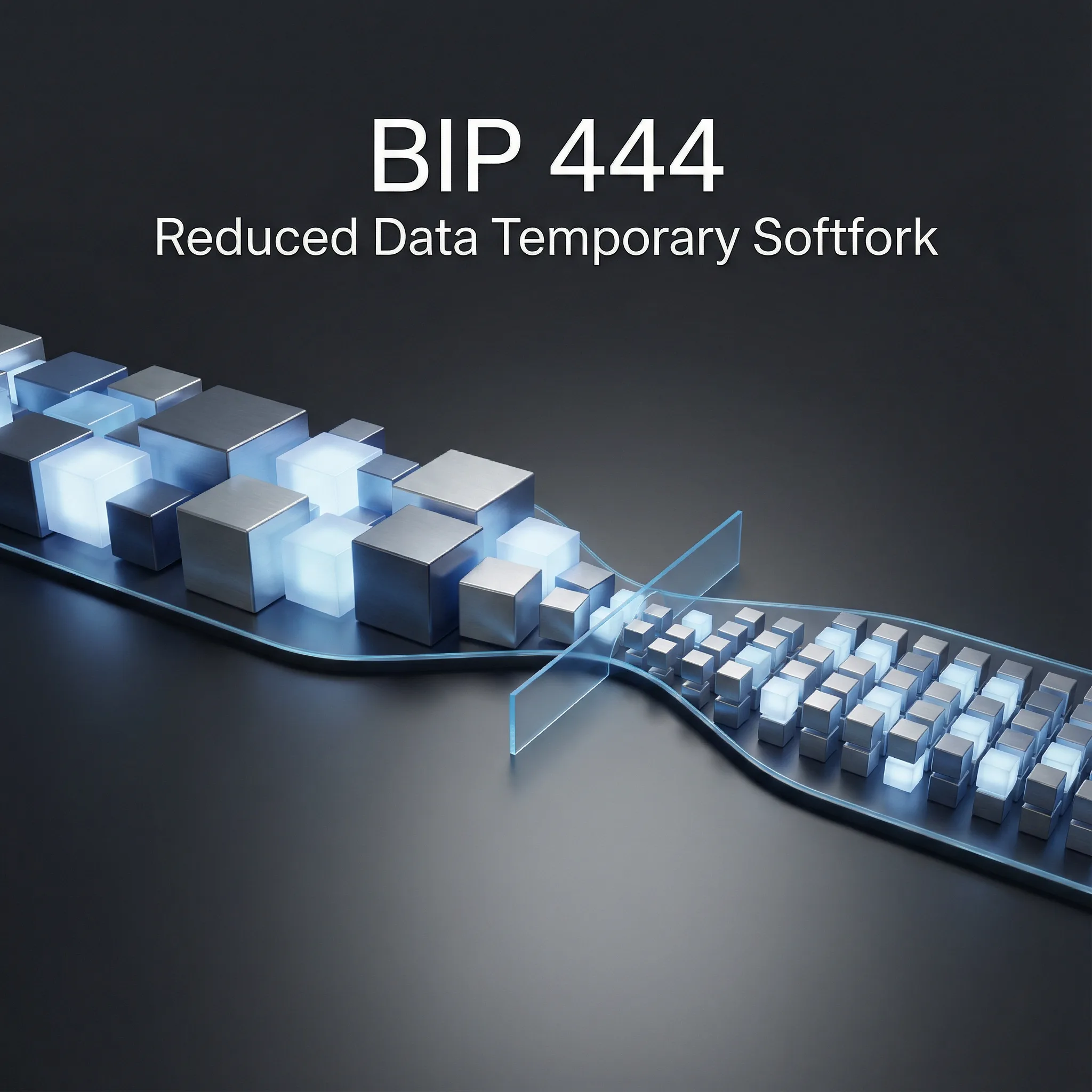
Bitcoin attracts a wide spectrum of users with differing motivations. Some view it as a long-term investment, others rely on it for direct peer-to-peer transfers, while many see it as a system that protects autonomy and eliminates middlemen. Regardless of perspective, participants depend on shared rules that guarantee decentralization and permissionless access.
As Bitcoin adoption grows, disagreements continue to surface over what the base layer should support. The most contentious debate today revolves around whether the blockchain should carry only financial transactions or remain open to broader data usage. BIP 444 — the Reduced Data Temporary Softfork — stands at the center of this discussion.
Why BIP 444 Was Introduced
Published on October 24, 2025 by a pseudonymous author known as Dathon Ohm, BIP 444 proposes a temporary soft fork restricting non-financial data within Bitcoin transactions. The proposal emerged in response to a surge in on-chain inscriptions, artworks, code experiments, and message chains encoded across Taproot and witness fields — for instance, users embedding pixel-by-pixel images or multi-line poems directly inside transaction data instead of storing them off-chain.
Supporters point to Bitcoin’s original purpose as set out in the white paper: electronic cash designed to function without trusted intermediaries. They argue that using Bitcoin as a general storage layer stretches its mandate and pushes scarce block space away from financial transactions.
Crucially, BIP 444 is time-bounded. It applies new limits for approximately one year, giving the network a window to evaluate whether looser policies should return or whether further refinements are necessary.
How BIP 444 Restricts On-Chain Data
BIP 444 applies caps at the transaction layer. OP_RETURN outputs, frequently used for metadata, are limited to 83 bytes. Most scriptPubKey forms would be capped at 34 bytes. This reduces the ability to write arbitrary payloads into scripts or output descriptions.
In addition, the proposal blocks indirect encoding methods. Limiting push sizes, shrinking Taproot control structures, and restricting witness annexes closes several loopholes used to store non-financial messages today.
Under these rules, transaction labeling remains possible — for example, attaching a short invoice ID or a payment reference — but distributing multi-segment files through the blockchain would no longer be feasible.

Baseline Conditions Versus Temporary Limits
| Parameter | Before BIP 444 | Under Temporary Limits |
| Allowed data purpose | Monetary + experimental payloads | Primarily monetary metadata |
| Practical capacity | Loosely constrained by script structure | Strict byte ceilings across fields |
| Encoding methods | Inscriptions, partitioned witness strings | Short identifiers only |
| Node resource impact | Accelerating growth | Reduced data-per-transaction footprint |
Arguments in Favor of BIP 444
Proponents of the soft fork highlight several growing risks. One is legal clarity. If prohibited content is written into an immutable ledger, individuals operating nodes may be placed in conflict with local law. Limiting data now, they argue, lowers the likelihood of that dilemma arising at scale.
Another concern focuses on decentralization. As block space is consumed by non-financial artifacts, overall blockchain size increases. Hardware requirements climb, pushing out smaller participants who cannot afford long-term storage, and concentrating validation among larger operators.
Finally, proponents argue that block space is a constrained resource that should prioritize the currency function. In their view, Bitcoin should not resemble a file archiver or digital museum but remain optimized for peer-to-peer transfers.
Supporters and Opponents: Goals and Concerns
| Group | Key Objective | Primary Concern |
| Supporters | Preserve monetary throughput and decentralization | Rising cost of validation and legal exposure |
| Opponents | Maintain protocol neutrality and flexibility | Restrictions becoming permanent or suppressing innovation |
Arguments Against BIP 444
Critics argue that Bitcoin derives strength from neutrality — any user constructing a valid transaction should not be judged on intent. Restricting fields based on assumed purpose edges toward policy-making rather than protocol enforcement.
Some doubt whether the soft fork solves its stated problem. Demonstrations have shown compressed payloads packed through chained scripts that still fit within limited byte budgets. If large payloads can be stored creatively, the restrictions add complexity without eliminating the outcome.
Another concern is innovation inertia. Features now considered normal — such as payment batching or time-based conditions — began as unconventional ideas. Critics caution that limiting “unusual” activity risks discarding ideas whose value is not yet obvious.
Impact Across the Bitcoin Ecosystem
BIP 444 forces the community to evaluate what the base layer should represent. If limits are applied and then expire, experimentation may return unchanged. If limits persist, they may unofficially become the new norm.
The proposal’s temporary nature makes future trajectories hard to predict, but likely outcomes illustrate how the discussion might shape long-term development.
One-Year Outcomes and Potential Consequences
| Outcome After One Year | Potential Ecosystem Result |
| Rules expire naturally | On-chain inscriptions and creative data return |
| Rules are renewed | Restrictions evolve into a de-facto default standard |
| Alternative proposal replaces BIP 444 | A refined compromise defines new norms |
| Disagreement deepens | Risk of incompatible implementations or social division |
These possibilities underscore the fact that a narrow technical proposal can exert wide influence — on tooling, developer priorities, and cultural expectations.
BIP 444 has become a defining moment in the negotiation over Bitcoin’s identity. While some see the temporary limits as a safeguard for decentralization and legal clarity, others view them as a threat to neutrality and experimentation. Even if the soft fork is never activated, the debate it sparked has already reshaped how the community thinks about Bitcoin’s purpose. By challenging assumptions, BIP 444 forces the ecosystem to consider what the base layer should represent in the years ahead.